
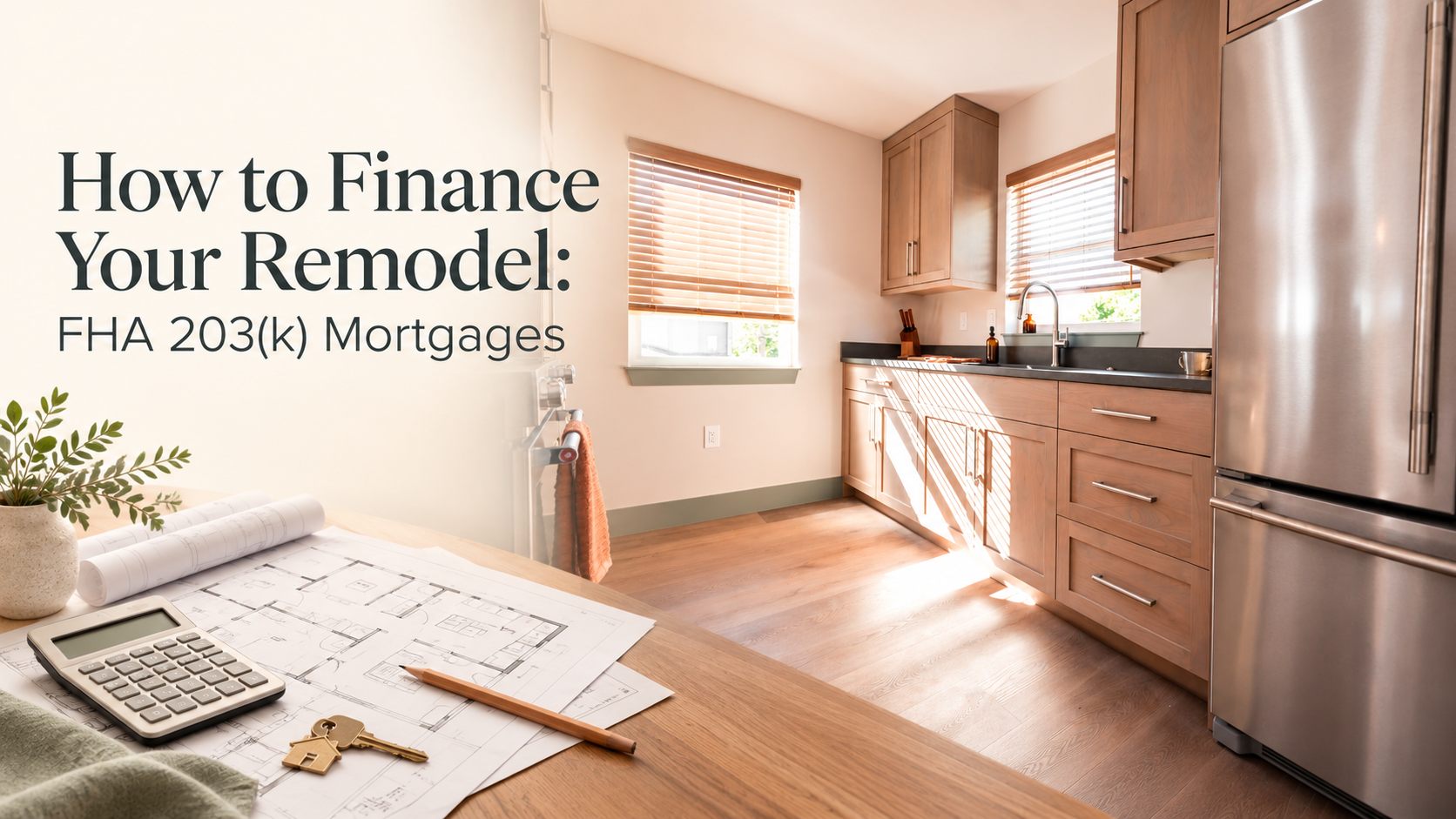
What is an FHA 203(k) loan?
An FHA 203(k) loan is a government-insured mortgage that lets you buy or refinance a home and finance its renovation in one loan, based on the home’s value after improvements. In 2026, the Limited 203(k) covers up to $75,000 of non-structural work. The Standard 203(k) covers major remodels, additions and eligible ADUs, up to the local FHA loan limit ($862,500 for a single-family home in the Denver metro).
Buying or Refinancing a Denver Home and Renovating It, in One Loan
An FHA 203(k) loan lets you finance a home and its renovation together, so you can buy an older Denver bungalow and turn it into the home you actually want. It is one of the few mortgages that lends on what your home will be worth after the work is done.
That matters in Denver. Homes in established neighborhoods like Washington Park, Platt Park, Berkeley and the Highlands often need more than paint. They need a second story, a primary suite, updated systems, or an accessory dwelling unit (ADU) in the backyard. Paying cash for the house and then finding separate money for the remodel is out of reach for most families.
FHA overhauled the 203(k) program in late 2024, and 2026 brought new loan limits and draw rules. This guide covers what changed, what a 203(k) can and can’t pay for, and how it compares with the other ways Sustainable Design Build (SDB) clients fund home additions, pop tops, ADUs, whole-home remodels and custom homes.
How an FHA 203(k) Loan Works
A 203(k) rolls the purchase price (or your existing mortgage balance) and the renovation budget into a single FHA-insured mortgage with one closing. The lender sizes the loan on the home’s appraised “as-completed” value, so the improvements themselves help you qualify.
The renovation money doesn’t go to you at closing. It sits in an escrow account and is released to your contractor in draws as work is completed and inspected.
A typical 203(k) runs like this:
- Find an FHA-approved 203(k) lender and get pre-approved.
- Define the scope and price. Your contractor (and, on a Standard 203(k), a HUD consultant) produces a detailed scope of work and cost breakdown.
- Appraisal on the home’s after-renovation value.
- Close on one loan. Renovation funds go into escrow.
- Pull permits and build. HUD requires all building permits before work starts.
- Draws and inspections release funds as phases are completed.
- Final inspection closes out the rehab account.
Because the loan depends on an accurate scope and a reliable price, the hardest part for most homeowners is step 2. That’s where a design-build firm earns its keep (more on that below).
Standard vs. Limited 203(k): What Changed for 2026
The Standard 203(k) is the version that fits additions, pop tops, ADUs and whole-home remodels. The Limited 203(k) (once called the “streamline”) is for smaller, non-structural updates. FHA’s Mortgagee Letter 2024-13, effective November 4, 2024, more than doubled the Limited cap and lengthened both timelines.
| Standard 203(k) | Limited 203(k) | |
|---|---|---|
| Best for | Additions, pop tops, eligible ADUs, structural and whole-home remodels | Kitchens, baths, flooring, roofs, windows, systems (non-structural) |
| Renovation budget | $5,000 minimum; no set maximum beyond the FHA loan limit | Up to $75,000 total rehab cost (was $35,000), reviewed annually |
| Structural work | Allowed | Not allowed |
| HUD 203(k) consultant | Required | Optional; fee can now be financed |
| Rehab period | Up to 12 months | Up to 9 months |
| Can you live elsewhere during work? | Yes; up to 12 months of mortgage payments can be financed as reserves (lender’s discretion) | Up to 30 days out of the home |
| Draws | Multiple, tied to consultant inspections | Increased draw count under ML 2026-06 |
Sources: FHA INFO 2024-44, HUD 203(k) industry briefing, DocMagic summary of ML 2024-13.
For most SDB projects, the Limited 203(k) is too small. Its $75,000 ceiling and no-structural rule rule out the work most Denver homeowners call us about. Think of the Standard 203(k) as the real option.
Can a 203(k) Pay for a Denver Addition, Pop Top or ADU?
Often yes, but the Denver loan limit is the deciding factor. Everything (the purchase price or your current mortgage payoff, plus the renovation, contingency and fees) has to fit under the FHA limit of $862,500 for a single-family home in the Denver metro in 2026 (FHA.com).
Here’s how that plays out for the projects we build. Cost ranges are SDB’s 2026 ballparks; your fixed price comes from our Project Concept Service.
|
Project |
SDB 2026 ballpark |
203(k) fit |
Learn more |
|---|---|---|---|
|
Home addition (main-floor primary suite, family room) |
$450–$650 per sq ft |
Good fit for a modest addition on a moderately priced home |
|
|
Pop top / second-story addition |
~$550–$650 per sq ft |
Possible but tight. A full second story usually pushes past the loan limit once the purchase price is added |
|
|
ADU (garage conversion, attached, above-garage) |
$400–$550 per sq ft; most Denver ADUs land around $260K–$550K |
Eligible improvement under the Standard 203(k), and part of the ADU’s expected rent can help you qualify |
Building an ADU in Denver · Garage ADUs · Can I build an ADU? |
|
$400–$550 per sq ft |
Good fit for buying a dated home and renovating it, if the total stays under the limit |
||
|
$500–$700 per sq ft; most land around $1.2M–$1.5M |
Not a fit. Budgets exceed the loan limit, and a teardown-and-rebuild is construction-loan territory |
A quick Denver example. You buy a $600,000 bungalow with 3.5% down. At the $862,500 cap, that leaves room for roughly $250,000–$290,000 of renovation once fees and contingency are counted. That covers a well-designed main-floor addition of about 400–500 square feet, or a garage ADU. It usually doesn’t cover a full pop top.
ADUs and the 203(k). FHA’s Mortgagee Letter 2023-17 made ADUs an eligible Standard 203(k) improvement. For some borrowers, 50% of the new ADU’s estimated rent can count toward qualifying income (National Mortgage News). Garage, basement and attached ADUs are the clearest fit; ask your lender early about a detached, new-construction backyard unit.
Internal note (remove before publishing): the 2025 ADU builder post lists lower ADU ranges (e.g., detached $110K–$285K) than SDB’s current $260K–$550K. Update that post so the numbers match before linking it here. Lender guidance on detached new-construction ADUs under 203(k) varies; confirm with Charles.
What a 203(k) won’t pay for: investment properties, and luxury items FHA treats as non-essential (such as a new pool). The home must be your primary residence.
2026 Requirements to Qualify
FHA’s minimums are lenient, but individual lenders often set stricter standards (called overlays), especially on renovation loans.
|
Requirement |
2026 rule |
|---|---|
|
Credit score |
500 minimum; many lenders require 580–620 or higher (NerdWallet) |
|
Down payment |
3.5% with a score of 580+; 10% with a score of 500–579 |
|
Loan limit (single-family) |
$862,500 across the Denver metro, including Denver, Jefferson, Arapahoe, Adams, Douglas and Broomfield counties (NFM Lending); $541,287 to $1,249,125 nationally (Wells Fargo) |
|
Mortgage insurance |
1.75% upfront (usually financed) plus an annual premium, most often 0.55% (SuperMoney) |
|
Occupancy |
Must be your primary residence |
|
Property |
Single-family homes (including those with an eligible ADU), 2–4 unit homes, and townhomes (HUD 203(k) fact sheet) |
|
Recent foreclosure |
Typically disqualifying within the past three years |
Down payment assistance from Colorado programs, and gift funds from family, can help cover the down payment.
The HUD Consultant, Draws and How Design-Build Fits
On a Standard 203(k), your lender must assign an FHA-approved 203(k) consultant from HUD’s roster for Colorado. The consultant reviews the scope and cost estimate, recommends a contingency reserve, sets the inspection schedule, and inspects work before each draw is paid.
That structure rewards a contractor who can hand the lender a complete, buildable scope and a firm number up front. A 203(k) built on a vague bid tends to stall: change orders eat the contingency, and draws wait on paperwork.
SDB’s design-build process lines up with what a 203(k) lender needs:
- Concept Phase → fixed price. Our Project Concept Service produces drawings you own, a scope of work and a fixed project cost, usually within a few weeks. That’s the package a lender and consultant need to size the loan.
- Design Phase → permits first. HUD requires building permits before work starts. We handle engineering and Denver permit approval in-house, so construction can begin as soon as the loan closes.
- Construction Phase → clean draws. One project manager, written change orders, and a Buildertrend portal with daily logs, photos and budget tracking make each draw inspection straightforward.
On Denver additions, pop tops and ADUs, design, engineering and permit review take a large share of the schedule. Start the Concept Phase before you close so the 12-month rehab clock covers construction, not paperwork.
Pros and Cons of a 203(k) Loan
Pros
- One loan, one closing, one monthly payment for the house and the renovation
- Borrow against the home’s after-renovation value
- Low down payment (3.5%) and flexible credit standards
- Fixed mortgage rates, typically lower than personal loans or credit cards
- Up to 12 months of mortgage payments can be financed if you need to live elsewhere during construction
- Rental income from a planned ADU can help you qualify
Cons
- FHA mortgage insurance (1.75% upfront plus an annual premium), usually for the life of the loan
- The $862,500 Denver loan limit caps larger projects, including most pop tops and all custom homes
- Primary residences only; no investment properties
- More paperwork: HUD consultant, draw inspections and a fixed rehab period
- Fewer lenders offer it, so shopping takes longer
Other Ways to Finance a Denver Addition, Pop Top, ADU or Custom Home
A 203(k) is one tool. For larger projects, homes you already own with a low-rate mortgage, or budgets above the FHA limit, other products usually fit better.
|
Option |
Best for |
Key 2026 limits |
|---|---|---|
|
FHA 203(k) Standard |
Buying or refinancing a home that needs a major remodel, addition or ADU |
$862,500 Denver-metro loan limit; primary residence only |
|
Buy-and-renovate with stronger credit; second homes and rentals allowed |
Renovation up to 75% of as-completed value; conforming limits apply; work done within 15 months |
|
|
Homeowners who want to keep their current low mortgage rate |
Up to 90% of the home’s after-renovation value; no refinance on certain products; no draws or inspections |
|
|
HELOC or home equity loan |
Owners with substantial equity today |
Based on current value, so often less borrowing power than after-renovation products |
|
Construction or construction-to-permanent loan |
Custom homes, teardowns and large pop tops |
Larger budgets; draw schedule and builder approval |
|
Cash-out refinance |
Owners whose current rate is close to today’s rates |
Replaces your first mortgage |
How SDB helps you finance your project
We aren’t a lender, but we make sure the money side lines up with the design and construction side from day one. Through our financing resources, clients can:
- Talk with Charles Edington, an ADU specialist and finance strategist with more than 20 years in mortgage and home improvement lending. As a broker with access to 180+ banks, credit unions and private lenders, he matches the loan to the project instead of forcing the project into one product. That includes HELOCs, home equity loans, renovation and construction loans, traditional mortgages and equity-based agreements, for ADUs, additions, pop tops, whole-home remodels and new custom homes.
- Explore RenoFi, our preferred renovation lending partner. RenoFi lends on your home’s projected after-renovation value (up to 90%), often lets you keep your existing mortgage and rate, and skips the draw schedules and inspections of a traditional construction loan.
- Use our financing estimator on the financing page to see how your current value, mortgage balance and after-renovation value translate into borrowing power.
The best time to bring a lender in is during the Concept Phase, once you have a fixed price to hand them. A real number, not an allowance-heavy bid, is what makes any renovation loan go smoothly.
Frequently Asked Questions
Does Sustainable Design Build work with 203(k) loans? Yes. We can provide the scope of work, drawings and fixed price a 203(k) lender and HUD consultant need, and we can connect you with financing professionals who handle renovation loans in Colorado.
What is the 203(k) loan limit in Denver for 2026? $862,500 for a single-family home across the Denver metro. The purchase price or payoff, the renovation and fees all have to fit under it.
How much can I borrow for renovations with a Limited 203(k)? Up to $75,000 in total rehabilitation costs, for non-structural work only. That’s up from $35,000 before November 2024.
Can I use a 203(k) to build an ADU in Denver? An ADU is an eligible improvement under the Standard 203(k), and part of its projected rent can help you qualify. Garage, basement and attached ADUs are the most straightforward; confirm a detached backyard ADU with your lender.
Can I use a 203(k) for a pop top or second-story addition? Yes, structural work like a pop top is allowed under the Standard 203(k). In practice, a full second story plus the home’s purchase price often exceeds Denver’s loan limit, so many homeowners pair a pop top with a construction or after-renovation-value loan instead.
Can I use a 203(k) to build a custom home? Generally no. A new custom home in Denver typically costs well above the FHA limit and is financed with a construction or construction-to-permanent loan.
Can I live in the house during construction? Often not during a major remodel. A Standard 203(k) can finance up to 12 months of mortgage payments while you live elsewhere.
Start With a Fixed Price
Whichever loan you choose, it works better with a real number behind it. Our Project Concept Service gives you buildable drawings you own, a fixed project cost and a realistic permit and construction schedule, so you can walk into a lender’s office ready.
Schedule a consultation or call (720) 667-4876 to talk about your Denver home addition, pop top, ADU, whole-home remodel or custom home.
Disclaimer: Sustainable Design Build is a design-build contractor, not a lender or financial advisor. This article is general information, not financial or legal advice. Loan programs, limits and lender requirements change; confirm current terms with an FHA-approved lender.
Sources
- HUD Mortgagee Letter 2024-13
- FHA INFO 2024-44: Updates to the 203(k) program
- HUD 203(k) industry briefing
- FHA Mortgagee Letter 2026-06
- HUD Mortgagee Letter 2023-17 (ADUs)
- HUD 203(k) consumer fact sheet
- FHA.com: Colorado 2026 FHA loan limits
- NFM Lending: Denver-metro 2026 loan limits
- Wells Fargo: FHA loan limits 2026
- SuperMoney: 2026 FHA MIP rates
- NerdWallet: FHA loan requirements
- NerdWallet: 203(k) vs. HomeStyle
- National Mortgage News: FHA ADU policy
- SDB Financing
Connect With Us
Planning your next renovation, or maybe you are looking to do a complete remodel for your home? Whatever the task, it can’t hurt to ask. Reach out to our team through this form.
We can schedule a free consultation and discuss everything you need to get your project moving in the right direction. Did we mention, it’s absolutely free?